Car Rental in Finland: Prices, Terms and Checklist
Picture the scene: you find a rental car online for €29 a day. You click Book, and at checkout the total is suddenly €140. Airport fee, additional driver, winter equipment, excess reduction, one-way charge – the rows add up bit by bit and eat the whole advantage.
This happens surprisingly often, even though renting a car in Finland is in principle easy. The difference between a cheap and an expensive rental is usually not the make of the car but whether you knew the terms in advance. This guide walks you through the 2026 price level, age limits, the deposit, the excess, winter tyres and a practical checklist from pickup to return. Prices and terms were checked in September–October 2026.

Quick answer: how much does car rental in Finland cost?
Renting a small car in Finland typically costs about €35–50 per day. The range is wide: offers start below €30, and in the winter season a premium or SUV class daily rate easily rises above €130. The biggest factors are the timing, the car class, the pickup location and the rental period. So always compare the total price, not the “from” price in the headline.
Daily price by car class
The table below is an indicative price level based on price tracking by comparison services (including DiscoverCars, Skyscanner and Momondo). The figures are euros per day, and they change with demand at the time of booking.
| Car class | Examples | Low season | High season |
|---|---|---|---|
| Mini / economy | VW Up, Toyota Yaris | €30–42 | €55–70 |
| Compact / estate | VW Golf, Skoda Octavia | €42–55 | €75–95 |
| SUV / 4x4 | Toyota RAV4, Volvo XC40 | €75–100 | €130–170 |
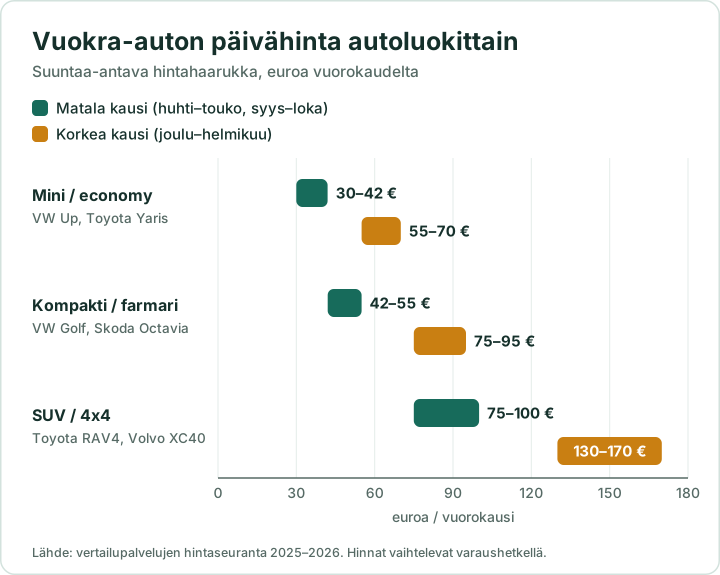 Daily prices by car class: in the high season an SUV costs more than twice as much as in the low season.
When is car rental cheapest?
Rental prices follow the rhythm of travel, and the difference between seasons is bigger than many people think:
- Cheapest months: April–May (small cars about €32–45/day) and September–October (about €35–52/day).
- Most expensive months: December–February, when the Lapland tourist season pushes prices up to €60–133 a day.
- Summer peaks: around Midsummer and in July demand grows and the most popular car classes can sell out. Book early at those times.
- Helsinki: economy and mid-range cars often go for €30–70 a day.
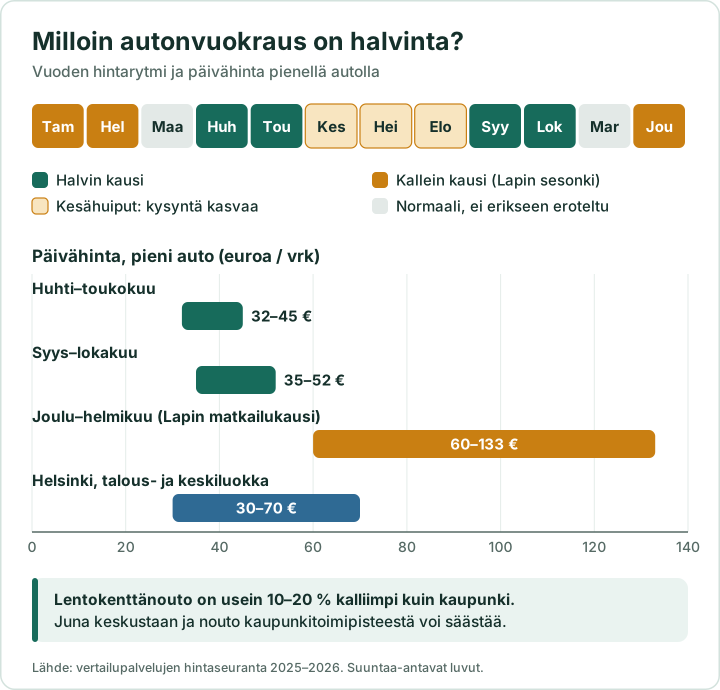 The price rhythm of the year: the cheapest months are April–May and September–October, the most expensive December–February.
Airport or city?
Picking up at the airport is convenient, but you pay for the convenience: the airport price is often 10–20 % higher than at the same rental company’s city branch. If you do not need the car immediately after landing, try a train or bus into the centre and pick up in the city. The saving can be a few tens of euros even on a weekend rental.
What is included and what is not?
The price is made up of more than one line. Always open the price breakdown before you pay.
| Price component | Check in the booking | Why it matters |
|---|---|---|
| Basic rental | Rental period, car class and pickup location | The same class can cost different amounts on different days and at different branches |
| Kilometres | Included kilometres and the overage rate | A cheap price suits short driving but not a long trip |
| Insurance | What is included, the excess amount and the exclusions | The name of the insurance alone does not tell you which damage you pay for yourself |
| Extra services | Additional driver, child seat, navigation, winter equipment | Can be charged per day or for the whole rental |
| Fuel or charging | Return level, refuelling or charging fee | The return condition can change the total cost |
| Return | Branch, opening hours and late-return terms | A late or off-site return can incur an extra charge |
The most common extra charges are the airport fee, the young driver surcharge (often €15–35/day for those under 25), an additional driver, a child seat and a one-way rental. Reducing the excess, that is Super CDW or zero excess, typically costs €10–50 a day.
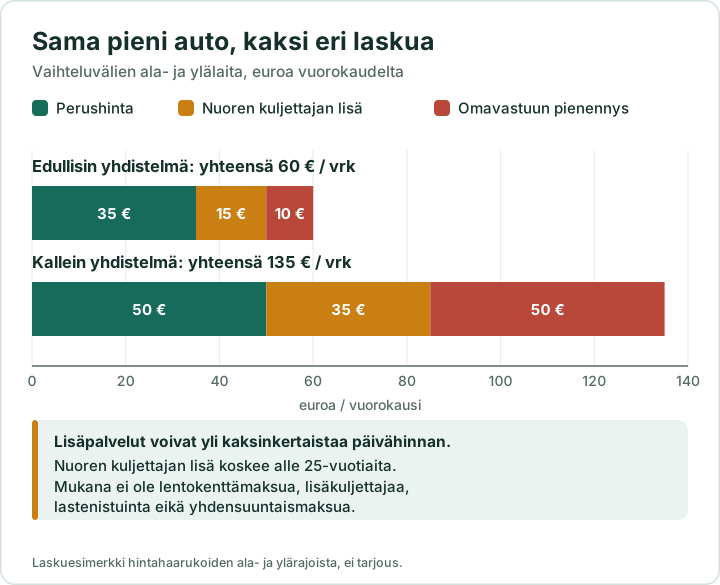 The same small car can cost €60 or €135 a day depending on which extras you add to the booking.
6 ways to lower the bill
- Compare using the same search. Use the same pickup and return times and the same car class across several services.
- Book early. In the normal season 1–2 weeks ahead is usually enough, but in summer and in the Lapland winter season booking weeks ahead is safer.
- Rent for longer. The daily price of a week’s rental is usually lower than that of a two- or three-day rental.
- Compare city and airport. See the tip above.
- Do not buy unnecessary protection. Check in advance whether your travel insurance or card benefit already covers something, before you accept expensive extra protection at the desk.
- Watch electric car offers. Rental prices for electric cars vary and campaigns appear from time to time. Check the charging terms, though, before deciding on price alone.
Car rental in Finland is growing steadily. Young people may not own a car at all, and tourism in Lapland keeps demand high. The most popular pickup locations are Helsinki, Rovaniemi and Turku.
What do you need to rent? Age, licence and deposit
The rental company’s own contract ultimately decides the terms, but the general rental terms of the Finnish Car Rental Association provide a basis that many rental companies follow. Here are the most common requirements at a glance:
| Item | Typical practice | Remember |
|---|---|---|
| Age | Usually 19–21 years; for premium cars and the SUV class 21–25 years or more | Hertz accepts a renter from the age of 18, but in some car classes the limit is 24. This is one rental company’s example, not a general rule |
| Driving licence | A valid licence, usually at least one year of driving experience | EU and EEA licences are accepted. Drivers from elsewhere may need an international driving permit in addition to the original licence |
| Payment card | A credit card in the driver’s name | A debit card is not always accepted, and according to Avis’s guidance the terms vary by country and car class |
| Deposit (security) | About €200–1,000 or more, often pre-authorised on the card | Released after the return, but it can tie up your card limit for days |
| Kilometres | Often unlimited | Some vehicles, such as motorhomes, have a mileage limit |
| Crossing the border | Prohibited without separate permission | Ask for permission in writing. Some rental companies allow travel to the Nordic countries, but the terms are always checked separately |
If your licence was issued outside the EU and EEA, check whether you need an international driving permit before you travel. According to Europcar’s guidance, an international driving permit can be mandatory alongside a licence issued in another country, a licence that is not in English, or one that is hard to read in the language of the rental country.
Also add everyone who will drive to the rental agreement before you set off. If damage occurs while the car is in the hands of someone other than the driver named in the contract, the insurance cover can lapse.
Insurance and excess: read this before you pay
This is where the worst surprises for renters happen. A basic rental usually includes third-party liability insurance and basic collision damage protection (CDW/TP), but the excess is typically €1,200–4,000 depending on the car class. One scrape in a car park can therefore cost more than a whole week’s rental.
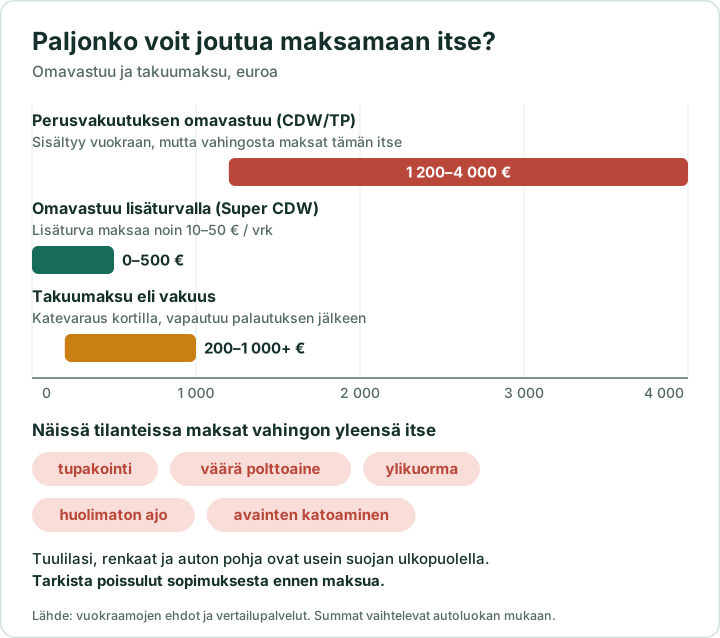 The typical ranges of the excess and the deposit. The deposit is not a cost, but it ties up your card limit.
The excess can be reduced with additional protection (Super CDW, SCDW or zero excess), but additional protection is not automatically all-inclusive. Compare the contract with this table:
| What the contract says | Check before booking | Do not assume |
|---|---|---|
| Damage cover | Which damage to the car is covered and what the excess is | That all damage or all parts of the car are covered by the same protection |
| Excess reduction | The new excess amount, the price and the exclusions | That “full cover” in the name automatically means €0 in every situation |
| Glass and tyre cover | Whether the windscreen, side windows, tyres, wheels and underbody are included | That they are included in the basic insurance |
| Roadside assistance | What happens if a tyre is punctured, keys are lost or the battery goes flat | That every service or every situation caused by the driver is free of charge |
| Driving area | Whether the rental is allowed only in Finland or also in other countries | That crossing a border is allowed without prior permission |
In which situations do you usually pay for the damage yourself?
Even if you buy additional protection, in certain situations the liability often stays entirely with the renter:
- Smoking in the car.
- Filling with the wrong fuel.
- Overloading.
- Careless driving, for example driving onto a flooded road or forcing the car into too tight a space.
- Losing the keys.
Hertz states in its Finnish terms that a rental car’s insurance cover and excess terms apply only in Finland. If you plan to drive abroad, ask the rental company for written permission and the terms for that particular trip before booking.
If a dispute arises, a consumer can take the matter to the Consumer Disputes Board. The board has handled disputes over excess charges and damage on rental cars, but its decisions are recommendations and each case is assessed individually. A better strategy is to avoid the dispute by photographing the car carefully and keeping the paperwork in order. More on that in the checklist.
Stone chips are also a typical source of rental disputes. Read first how to deal with stone chip repair and its price, so that you know what is involved.
Passenger car or van?
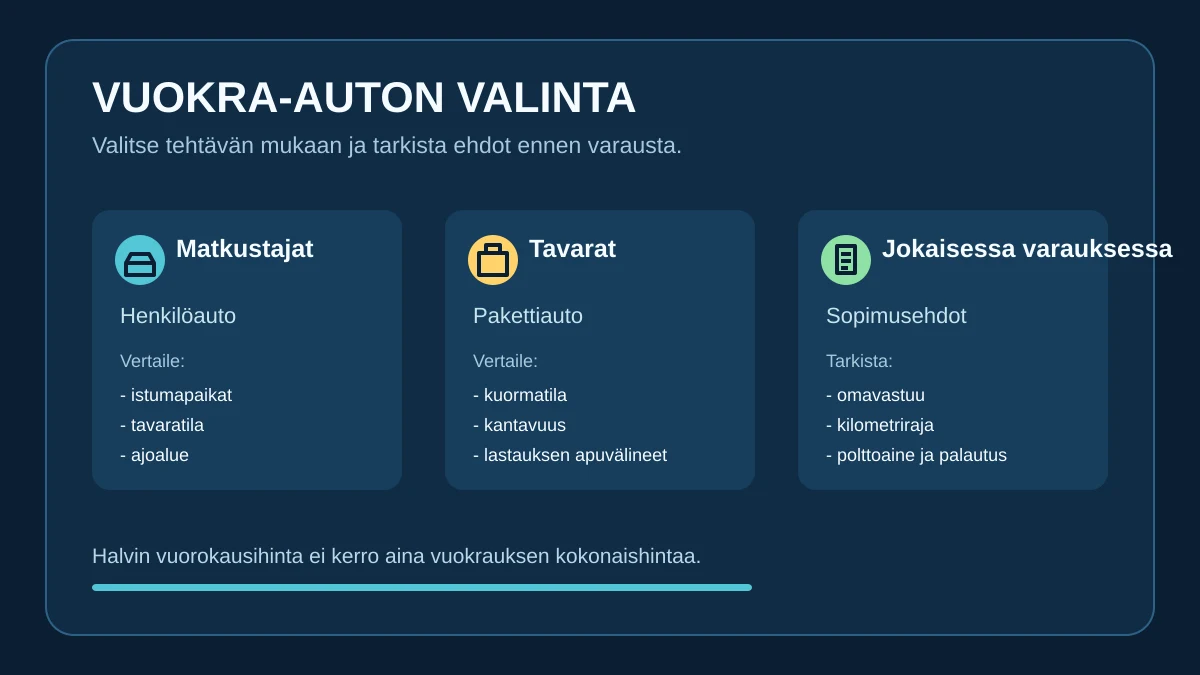
Choose the car by the job, not just by the size in the pictures.
A passenger car suits carrying people, commuting and holidays. Compare the seats, the boot volume in litres, the transmission, the power source and the winter equipment. If you have a child seat, a pram or ski gear with you, check the boot by practical measurements.
A van suits transporting goods, but the load space alone does not settle it. Confirm the internal dimensions, the payload, the load restraint points, the loading height and whether you need a trolley or another aid. Also check that your own licence category is enough for that vehicle.
An SUV or 4x4 is a sensible choice if you are heading to Lapland in winter or driving on gravel roads. For a city trip it is usually unnecessarily expensive.
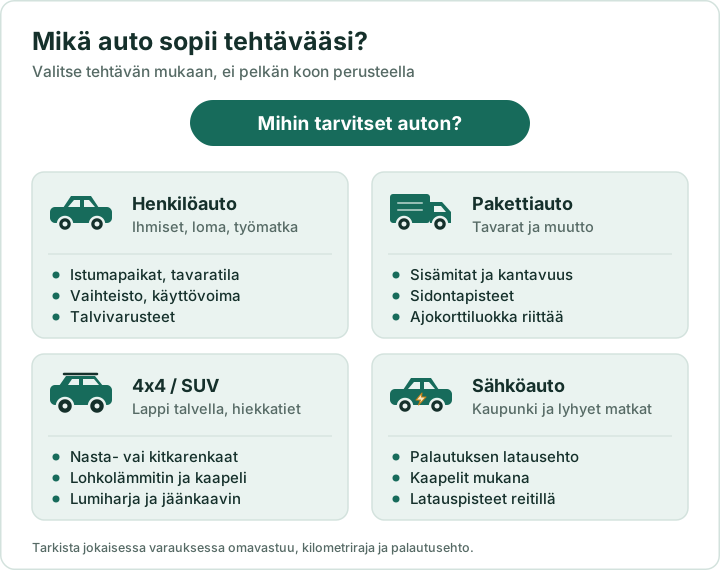 Choose the car by the job and check each type’s own special features.
If you need a car only because your own is being repaired or because you are still deciding whether to buy one, compare the total cost of renting with your own needs. The used car buying guide helps you judge when a car you are about to buy should be checked before the deal.
Renting an electric car: charging and returning
An electric car is available to rent in more and more places, and you can find one at a campaign price. A few things are still worth checking before you book:
- Return level: with a petrol car the return condition is usually “full tank”, but with an electric car the rule can be different. Some rental companies want the car returned at the same charge level as it was picked up, and some terms require a certain minimum percentage, for example 70 %. Charging to a full 100 % takes time and is not usually required. Read the exact requirement in the contract.
- At pickup: note the battery charge level from the dashboard and make sure the charging cables are in the boot.
- Charging network: in the Helsinki region there are plenty of charging points, but in Lapland and in sparsely populated areas you should plan the trip around charging stops. In freezing weather the range shortens.
- Return: plan the last charge well before the return. Charging is slower than refuelling, and it is not worth leaving to the last moment.
Car rental in winter: tyres, heating and snow
Driving in winter is a category of its own in Finland, so a car rented in winter deserves particular attention.
The winter tyre law in brief
Under the Road Traffic Act, winter tyres must be used between 1 November and 31 March if the weather or road conditions require it. The earlier fixed winter tyre requirement for December–February has been removed, so what matters is the conditions, not the calendar. The main grooves of winter tyres must be at least 3 mm deep. In an inspection the police assess whether the conditions are wintry. A violation can bring a fine of about €100.
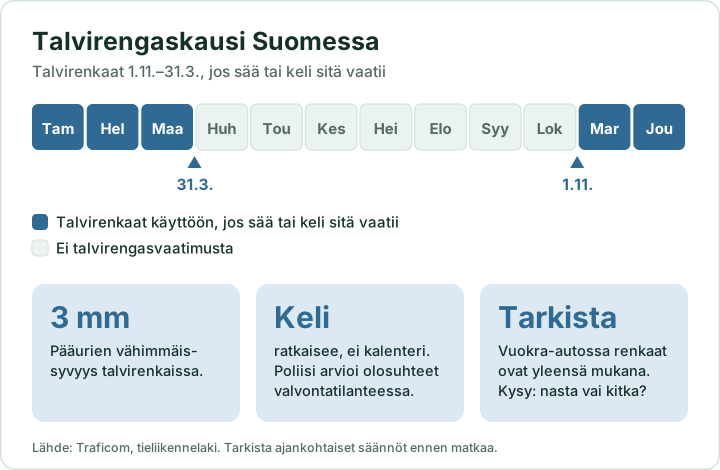 The winter tyre season on a calendar: the conditions decide, not just the date.
The good news: rental cars usually come with winter tyres. Responsibility for driving according to the conditions always rests with the driver, though, so check the type and condition of the tyres at pickup.
Studded or friction tyres?
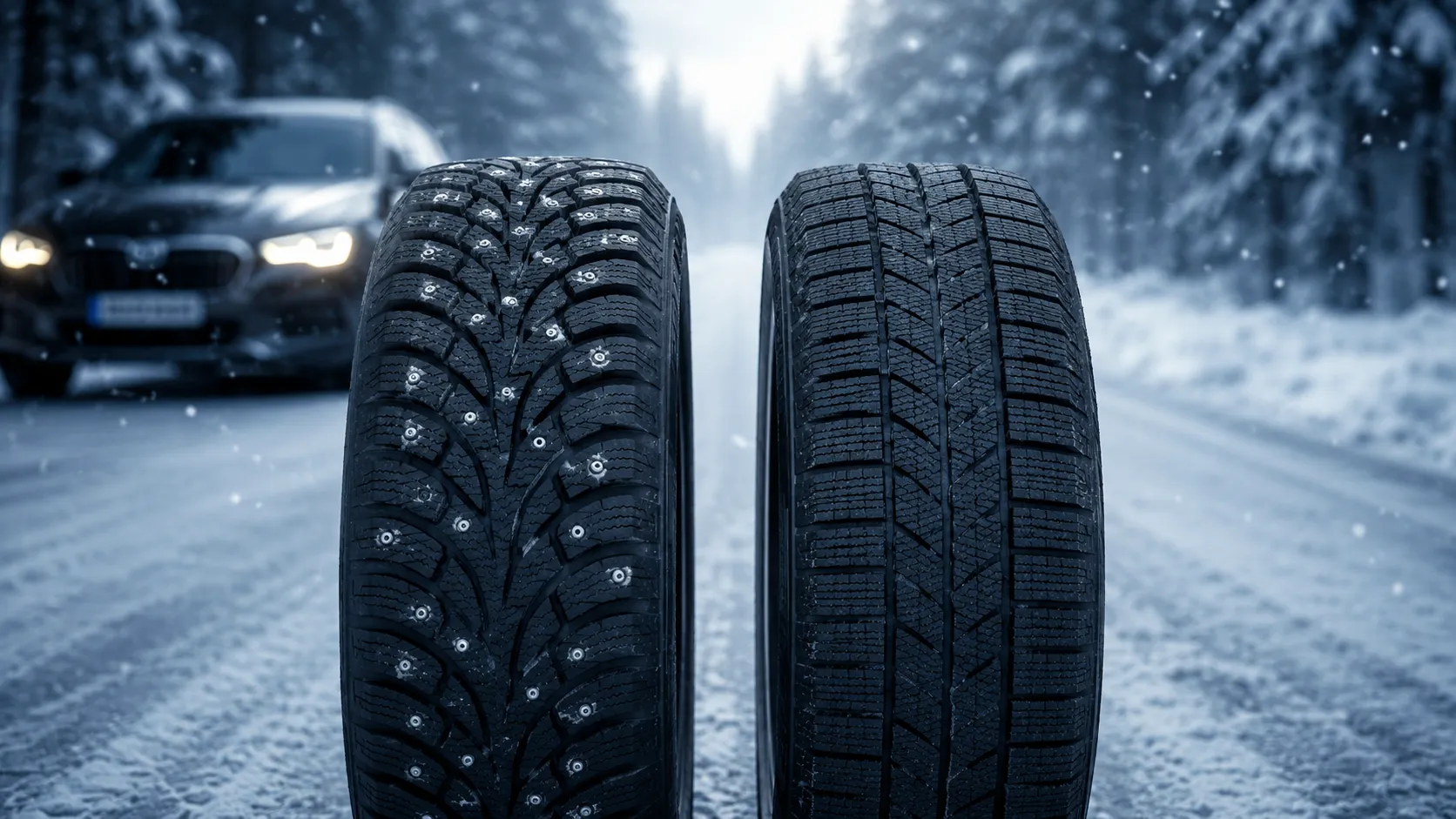
Studded tyres give the best grip on icy roads and are especially suited to northern Finland. Friction tyres are quieter and more comfortable, and they cope well on the salted and gritted roads of southern Finland. Friction tyres usually carry the snowflake marking (3PMSF). If you are driving in Lapland or you are an inexperienced winter driver, studs are the safer choice. You can find a comparison in the guide studded or friction tyres.
Winter checklist for a rental car
- Make sure the car has a snow brush and an ice scraper.
- Ask whether the car has an engine block heater and its cable. In freezing weather they are valuable.
- Remove snow and ice from the roof before setting off, so that they do not fly onto the car behind.
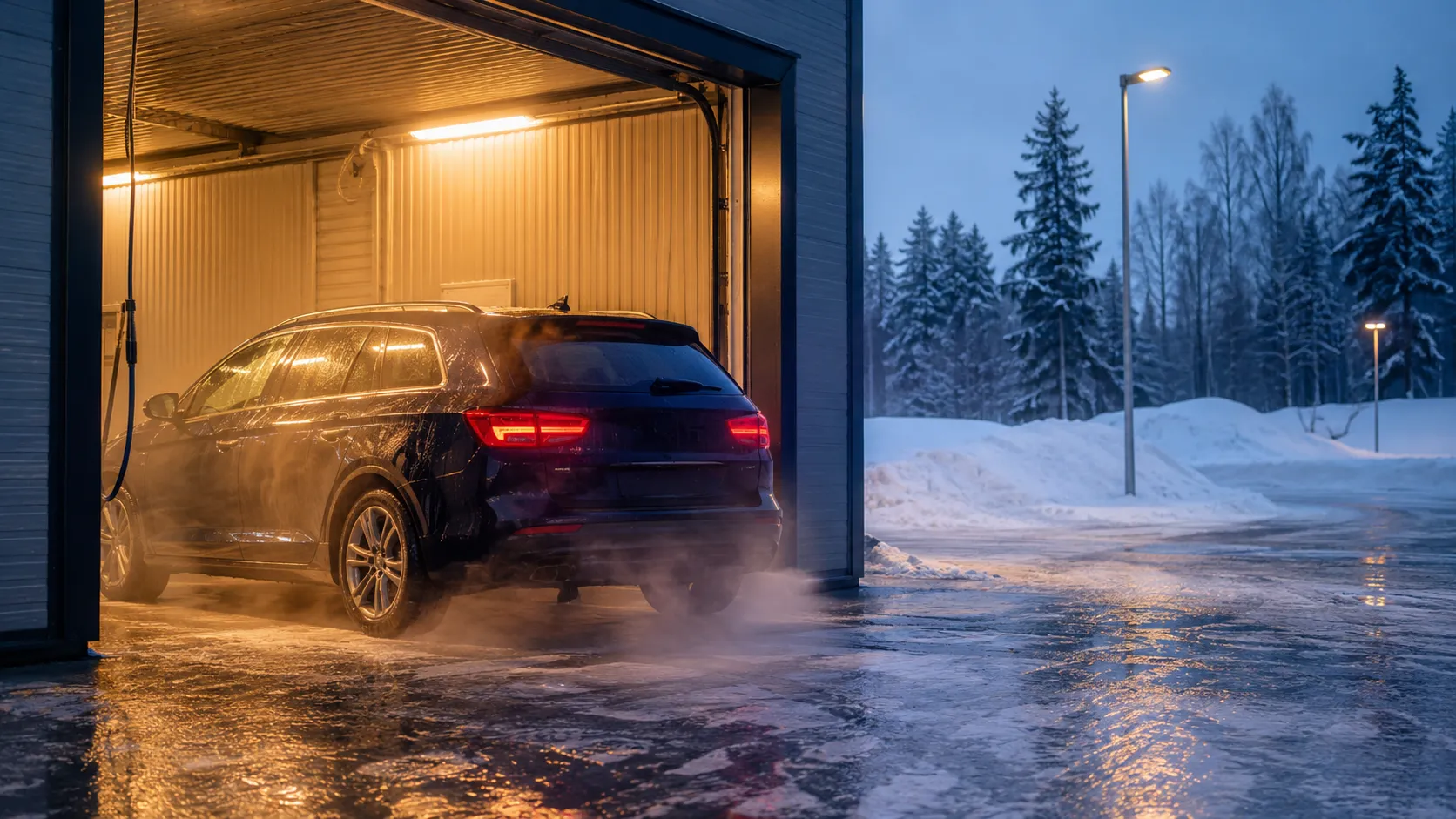
- Top up the windscreen washer fluid. Salt and slush use it up quickly. If you have time, also read washing a car in winter.
- Keep more fuel or charge than in summer. Frost uses up both faster.
The winter tyre season starts by law on 1 November, so if you are renting a car in the coming weeks, prepare for winter conditions already.
Traffic rules a rental car driver should know
Even if you drive regularly at home, a few things are worth checking when driving a rental car in Finland:
- Headlights are kept on at all times while driving, even at midday.
- The alcohol limit is 0.5 per mille. The best option is not to drink at all.
- Speed limits: typically 50 km/h in built-up areas, 80–100 km/h on main roads and at most 120 km/h on motorways in summer. In winter the limits are often lowered.
- There are no road tolls. A free road network is an easy message for a visitor.
- Animals on the road: moose – and reindeer in Lapland – appear on the road without warning, especially at dusk. Slow down at warning signs and report a collision both to the emergency number 112 and to the rental company.
- Seat belt and mobile phone: the belt is compulsory for everyone, and the phone must not be held in your hand while driving.
Car rental checklist
Print this or take a screenshot. Every item is written on the basis of a bill that somebody paid.
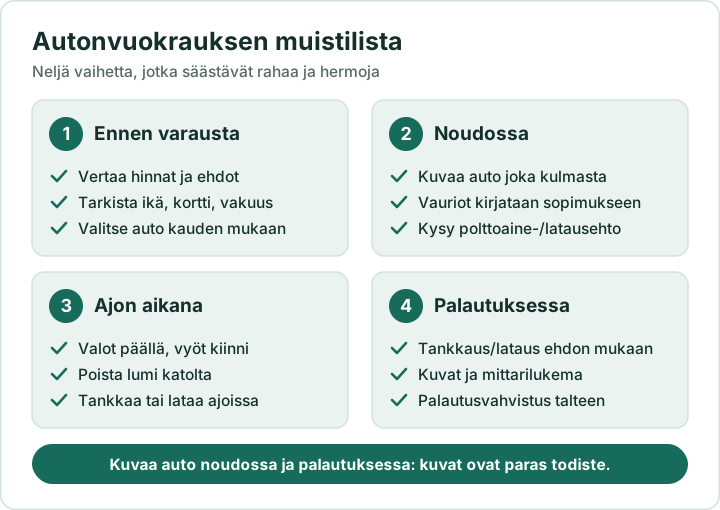 The checklist in a nutshell. You will find the detailed checklists below.
Before booking
- Compare prices with at least two services for the same dates and the same car class.
- Read the terms for the excess, the fuel or charging condition, the kilometres and the winter tyres.
- Check your age, the validity of your licence and the rental company’s deposit requirement.
- Choose the car by season: a 4x4 for Lapland, an electric car only if the charging network is enough.
- Book child seats in advance.
- Any trip outside Finland is approved in writing.
At pickup
- Photograph or film the car’s exterior, wheels, windows and interior before you leave, from every angle.
- Go through all the already marked damage with the staff and ask for any missing observations to be recorded in the contract.
- Check the fuel or charge level, the odometer reading and the cables, keys and accessories included.
- Ask about the fuel policy, the return instructions (including the night box) and how to get help in a breakdown or an accident.
- Decline expensive upsells if you already have equivalent protection, for example in your travel insurance or as a card benefit.
While driving
- Follow the traffic rules: lights on, seat belts fastened, no hand-held phone.
- Remove snow and ice from the roof.
- Refuel or charge in good time, and do not leave it to the last moment.
- If the car develops a fault, a warning light comes on or you have a collision, contact the rental company immediately.
At return
- Return the car at the agreed time and to the agreed place.
- Meet the fuel or charging condition exactly as agreed and keep the receipt.
- Photograph the car again, especially the odometer reading and the fuel level. This matters most if the return is made without staff.
- Keep the return confirmation and the final invoice.
- If you notice damage, report it to the rental company immediately as the contract instructs.
Frequently asked questions
How much does car rental cost in Finland?
Renting a small car typically costs about €35–50 a day, and offers start below €30. Premium cars and SUVs cost €80–150 or more. The price depends on the timing, the car class, the pickup location and the rental period. Compare the total price, not just the “from” price.
What is the excess on a rental car?
The excess is the amount you pay yourself if the rental car is damaged. In a basic rental it is typically €1,200–4,000 depending on the car class. With additional protection (Super CDW or zero excess) the excess can be reduced, but the windscreen, tyres and underbody are often outside the cover.
How old do you have to be to rent a car?
The age limit varies by rental company, country and car class. Usually the limit is 19–21 years, and for premium cars or the SUV class 21–25 years. Hertz in Finland, for example, accepts a renter from the age of 18, but in some classes the limit is 24. Renters under 25 are often charged a surcharge.
Do you need a credit card to rent a car?
Most rental companies want a credit card, because the deposit (about €200–1,000 or more) is held on the card. A debit card is not always accepted. The cardholder’s name must usually match the renter named in the contract. Check the card and deposit terms with the rental company before pickup.
Do rental cars have winter tyres?
Under the law, winter tyres must be used between 1 November and 31 March if the weather or road conditions require it. The main grooves must be at least 3 mm deep. Rental cars typically come with winter tyres, but responsibility for driving according to the conditions rests with the driver. Check whether the tyres are studded or friction.
Can I drive a rental car abroad?
Do not assume so. The rental company’s insurance and driving area terms can restrict use to Finland. Crossing a border is usually prohibited without separate permission. Get written approval and the terms for crossing the border before your trip. Some rental companies allow driving to the Nordic countries under additional terms.
Do I have to return an electric car with a full battery?
Not always. With electric cars the return condition is often the same charge level as at pickup, or a certain minimum percentage, for example 70 %. Charging to a full 100 % takes time and is usually not required. Check your own contract, however, for the return condition that applies.
Van or passenger car for moving?
Choose a van when you are carrying furniture or other items that cannot be carried safely in a passenger car. Compare the internal dimensions of the load space, the payload and the lashing options. If you are carrying more passengers than cargo, a passenger car may be more practical.
Compare car rental companies near you
Compare car rental companies by service range, location and reviews. You can also find options in Helsinki, Tampere and Rovaniemi. You can ask a rental company for more details about a car that suits your booking using the request-a-quote form.
Prices and terms change, so always check the final details on the rental company’s own pages at the time of booking.
Sources
- Hertz: rental terms and service prices — Finnish age, payment card, driving area and return terms; checked 9 September 2026.
- Avis: guide to car rental — driving licence, credit card and country-specific variation in the terms; checked 9 September 2026.
- Europcar: documents to present at pickup — the terms for a foreign licence and an international driving permit; checked 9 September 2026.
- DiscoverCars: charging and returning an electric car — the principles of the return charge level for an electric car; checked 10 October 2026.
- Verkkouutiset: Winter tyres on according to weather and conditions — Traficom’s release on the winter tyre law and the 3 mm groove depth; checked 10 October 2026.
- Finnish Car Rental Association: general rental terms — driving experience, driving area and the renter’s obligations; checked 10 October 2026.
- Price tracking by comparison services (DiscoverCars, Skyscanner, Momondo) 2025–2026 — indicative daily prices and seasonal variation; prices change at the time of booking.