Studded or Friction Tyres: Which Winter Tyres to Choose
Studded or friction tyres? There is no one answer that suits every Finnish driver. Think about the icy side roads you actually use, whether your journeys are mostly on snow or well-cleared asphalt, and what your winter trips look like. Tyre quality, size and condition matter just as much as the presence of studs.

Quick answer: which type should you choose?
According to Traficom, studded tyres provide better grip on icy roads, while non-studded winter tyres (friction tyres) work best on snowy roads. Studs are worth comparing if you regularly drive on ice, slush-covered ice or poorly maintained side roads. If your routes are mainly snowy or well maintained and you value a quieter ride, look at friction tyres designed for Nordic conditions—especially models with an ice-grip marking.
Tyre type alone does not determine safety. In a 2025 test published by Autoliitto’s Moottori, a new premium friction tyre outperformed a new budget studded tyre on ice. Compare products in the same size that fit your car, and read independent test results instead of judging only by stud count or purchase price.
| Decision factor | Studded tyres | Friction tyres |
|---|---|---|
| Icy roads | Traficom says they provide better ice grip. | Choose a Nordic model; an ice-grip marking signals suitability for demanding conditions. |
| Snowy roads | A good option when the tyre is high quality and in good condition. | Traficom says they work best on snow. |
| City driving and road dust | Studs wear the road surface more and can increase fine particles. | No stud-related road wear. |
| Period of use | Permitted 1 November–31 March and at other times when conditions require them. | Use is not restricted by season. |
| Essential check | All tyres must be studded on a passenger car or van when studs are used. | A non-studded winter tyre for a passenger car or van must have the 3PMSF snow-grip marking. |
Choose for your actual winter routes
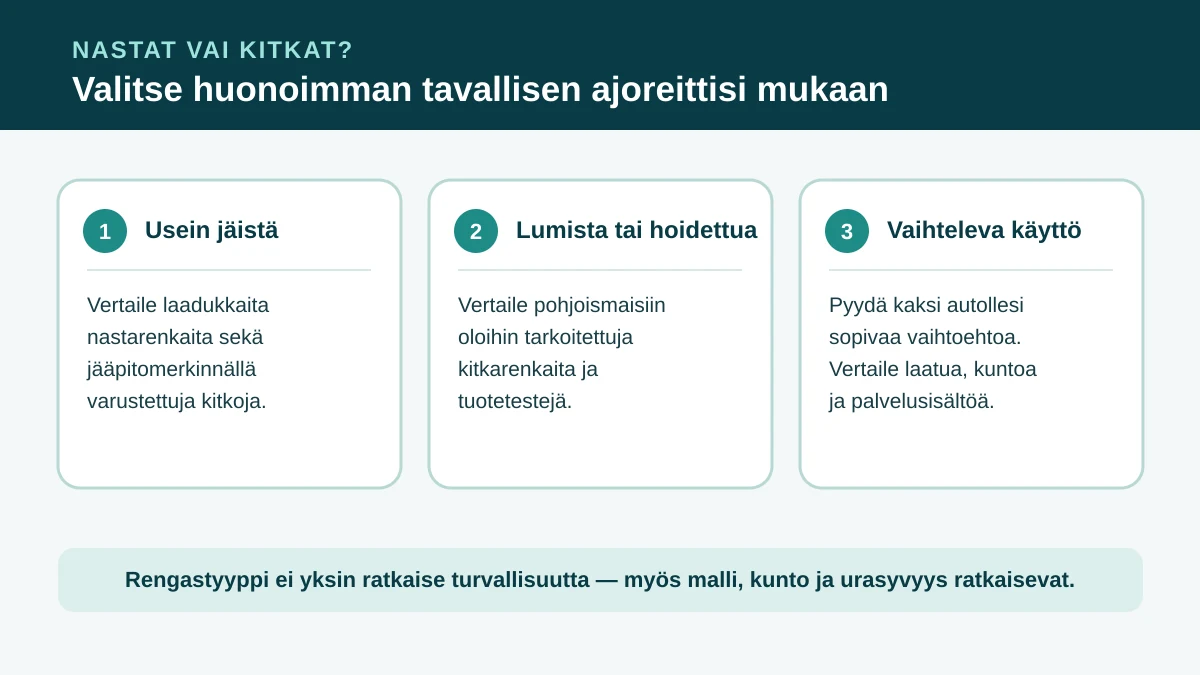
Start with an honest question: what kind of road do you drive when conditions are at their worst? A daily early-morning commute on a small icy road is a very different use case from city driving on ploughed main routes.
Compare studded tyres first if your routes often include ice, wet ice or unploughed side roads. Still check model-specific tests and wear. Studs cannot make a weak or worn tyre safe.
Compare friction tyres first if you mostly drive on snow or well-maintained roads, want to avoid stud use and can adapt your speed to conditions. Check for the 3PMSF marking. An ice-grip marking is not mandatory, but Traficom says it indicates suitability for demanding winter conditions.
If your driving is varied, do not decide from your postcode alone. List a normal week of winter journeys, early departures and trips to a cabin or workplace. Ask a tyre shop for quotes on two suitable, similarly rated options for your car.
The rules in Finland
Passenger cars and vans must use winter tyres from 1 November to 31 March when weather or road conditions require them. The main grooves must be at least 3.0 mm deep. In difficult snow and slush, Traficom recommends at least 5 mm.
Studded tyres may be used from 1 November to 31 March and outside that period when conditions require them. On a passenger car or van, studs must be fitted to every wheel. Friction tyres can be used all year, but the current winter-tyre requirements still apply when winter conditions demand them. See sections 105 and 106 of the Road Traffic Act.
Also watch local traffic signs. According to Autoliitto’s summary, some of Helsinki’s Lönnrotinkatu has a studded-tyre ban in force until spring 2028.
How much does a winter-tyre set cost?
The price depends on tyre size, brand, type and whether fitting and recycling fees are included. Compare the same size and service scope. These examples are not a direct studded-versus-friction price test; they show how size and product level affect the bill.
| Example, checked 9 September 2026 | Price and contents | What it shows |
|---|---|---|
| Euromaster: Kumho WI32 205/55 R16 | €115 per tyre + fitting €27.25 per tyre | Studded-tyre and fitting prices are itemised. |
| Euromaster tyre search, 205/55 R16 | Michelin X-Ice North 4 studded €175.01 per tyre; X-Ice Snow friction €170.01 per tyre | Premium models in the same size can be close in price. |
| Vianor: Nordman North RS3 205/55 R16 | €689 for four fitted, recycling fee included | Check which labour is included in the total. |
Enter your registration number or exact tyre size in the shop’s search before ordering. This shows the approved options, load and speed ratings and the cost of fitting for your car.
Keep either tyre set in good condition
- Measure tread depth before every winter and watch for uneven wear.
- Check pressures according to the manufacturer’s instructions, including in freezing weather.
- On studded tyres, look for missing or loose studs and consider the tyre’s age.
- Keep stored tyres away from oil, solvents and UV light.
- Keep the full set as even as possible. If you replace only two tyres, follow the owner’s manual and safety guidance on where the better pair should go.
For practical change and storage instructions, read the tyre-change and storage guide.
Frequently asked questions
Which is better: studded or friction tyres?
Traficom says studs provide better grip on ice, while friction tyres work best on snow. The better choice for you depends on the worst ordinary route you drive and on the quality of the specific tyre model.
When can studded tyres be used?
Studded tyres may be used from 1 November to 31 March and outside that period when weather or road conditions require them. On a passenger car or van, studs must be fitted to every wheel.
Can friction tyres be used all year?
Yes, their use is not restricted by season. In winter conditions they must still meet the applicable winter-tyre requirements, and a worn winter tyre is not a good summer-tyre substitute.
How much do winter tyres cost?
The total depends on size, brand and whether fitting is included. In the 205/55 R16 examples checked on 9 September 2026, one tyre cost €115–175.01, with fitting either added separately or included in a package. Ask for a total price for four tyres.
Compare winter tyres and tyre shops
Compare tyre shops and request quotes for studded and friction options that fit your car. Find shops in Helsinki, Oulu and Rovaniemi.
Sources
- Traficom: summer and winter tyres — grip, 3PMSF and ice-grip markings, tread depths; checked 9 September 2026.
- Finlex: Road Traffic Act sections 105 and 106 — winter and studded-tyre use; checked 9 September 2026.
- Autoliitto: winter-tyre test — the importance of tyre type, product level and wear; checked 9 September 2026.
- Euromaster and Vianor — product information and prices; checked 9 September 2026.
- Autoliitto: winter rules in Europe — Lönnrotinkatu studded-tyre ban; checked 9 September 2026.